

27 Oct Once Upon My HVAC System
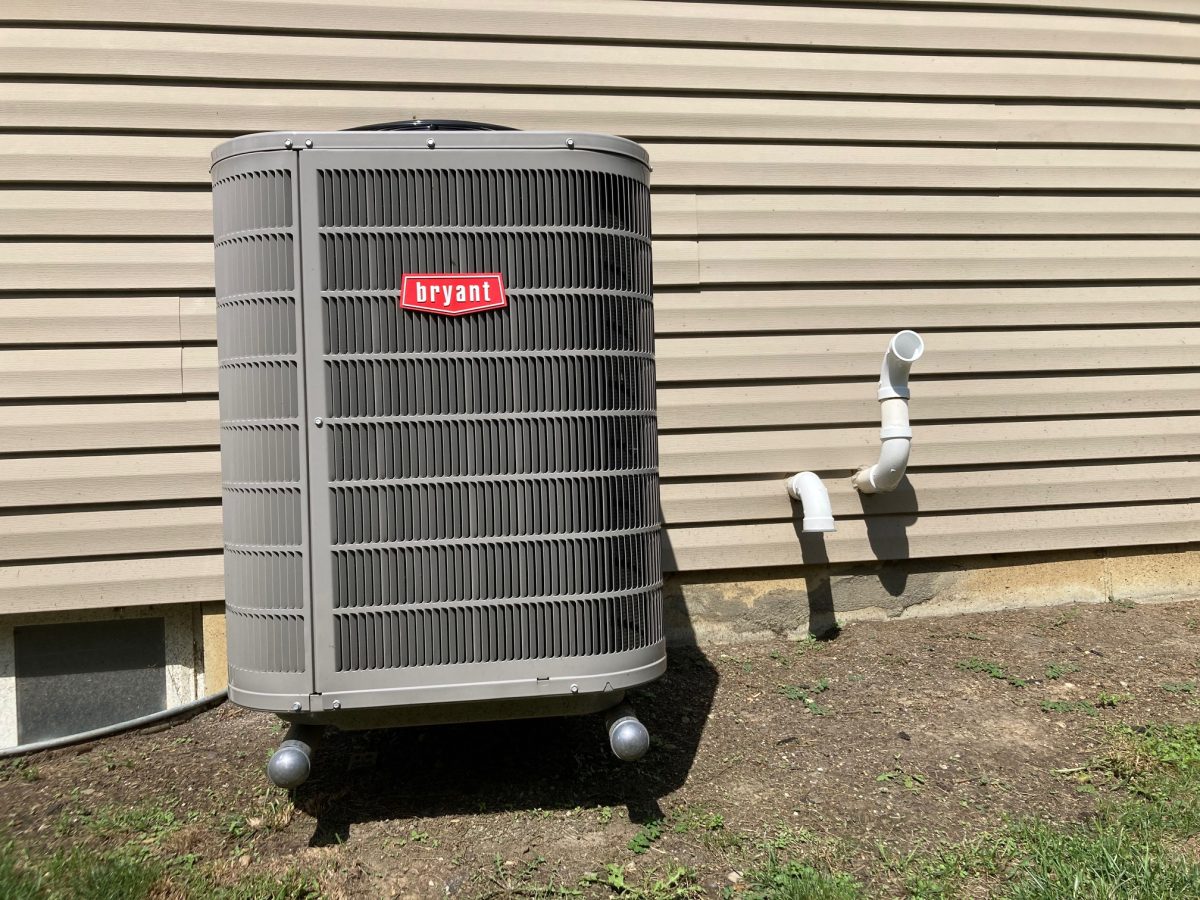
Once upon a time, the sun was shining on a warm Spring day in 2025. I was feeling proud that I’d actually scheduled HVAC servicing before the hot, humid summer days in Ohio’s Little Miami Valley set in.
But this happiness was momentary. The service technician quickly announced that the air conditioner was dead and in need of replacement. I was gripped with fear — not because it would cost, but because we had been through a dramatic ordeal back in 2015 to abate high humidity levels in our home. This problem was caused by this HVAC company installing an air conditioner, at the time the home was built, with an incorrectly sized piston.
After much arguing and money spent on experts, the company replaced the piston. From then on, we’d been able to keep our indoor humidity levels where they are supposed to be — between 30 and 50 percent as recommended by the U.S. EPA — to prevent mold, mildew and dust mites.
Was I about to go through this problem all over again? Of course not, the company said.
Always ensure your HVAC system is correctly sized
I explained the history to the salesperson who had come to assess what type of new air conditioner we needed. And I gave a him a copy of the load study we paid for in 2015. He took it to one of the company’s top technicians. A load, or Manual J, calculation applies an engineering standard developed by the Air Conditioning Contractors of America. It determines the exact heating and cooling capacity a home requires.
The engineer determined that my home needed a 2-ton condenser coil, and a 2.5-ton evaporator coil.
“What about the piston size and the problem we had before?,” I asked.
“These systems don’t use pistons anymore,” he said.
Here is where I should have asked if they would be installing a 2-ton Thermostatic Expansion Valve (TXV) in the 2.5-ton evaporator coil. But I didn’t know that TXV’s have replaced pistons when it comes to high-efficiency air conditioning and heat-pump systems, though pistons are still used in entry-level base models.
I also didn’t know that last-minute switches can occur at the warehouse when your technicians go to pick up your new unit on installation day.
Soaring indoor humidity signals mismatched parts or system-sizing problems
And so, our new 16-SEER system was installed, and we were ready for summer. Or so we thought, until Summer kicked in, and our indoor hygrometer soared above 60 percent. Moisture was running down the inside of our windows, and mildew had started to appear on the window ledges.
“It’s just very humid out!,” the salesman said when customer service transferred my call to him. “Everyone’s having the same problem.”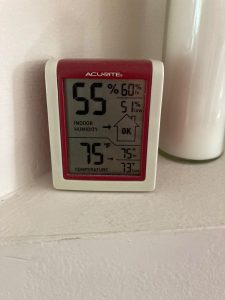
I turned the temperature down. It was too cold to stay inside without a jacket. But, the indoor humidity wouldn’t budge below 53 percent.
Winter came, the problem stopped. Spring 2026 arrived, and it started again. My calls to customer service were sent to the manager. He cited one personal delay after another while months ticked by.
His last emails to me actually emphasized that my own load study dictated that they install a 2.5 evaporator coil with the 2-ton condenser coil, and that my only solution was to spend another $3,000 on a whole-home dehumidification system.
“I want the air conditioner fixed first,” I said.
Consult another expert
“There is nothing to fix,” the manager said. “Air conditioners are not dehumidifiers,” when we all know that’s what air conditioners do.
Now, I knew it was time to call another expert.
I turned to Karen Barras, energy auditor at Energy Efficient Homes Midwest and energy coordinator for Greater Cincinnnati’s Well-Dwelling Experts Network (WDEN).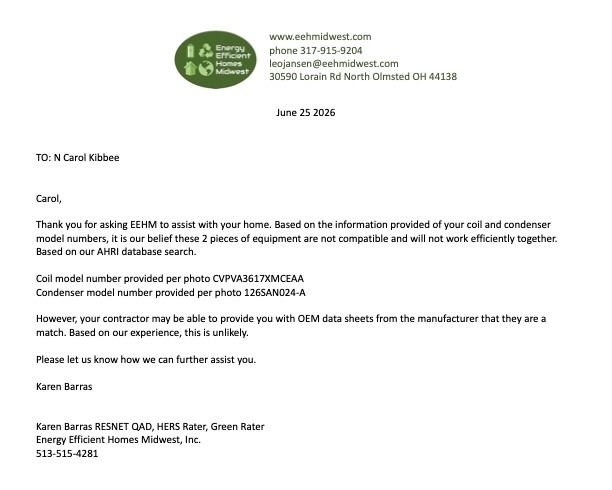
Her answer was quick: “Based on the information provided of your coil and condenser
model numbers, it is our belief these two pieces of equipment are not compatible and will not work efficiently together.”
Barras’s review revealed that the HVAC company had installed a 3-ton evaporator coil — not the 2.5 ton coil the 2015 load study called for — with a 2-ton condenser coil. And even though Barras’s letter forced them to review their paperwork and admit their error, there still was no mention of the properly sized TXV to allow the differently sized coils to work together.
“Unfortunately, this happens more often than you would think,” Barras said. “Homeowners don’t have enough information to understand what is happening, so it happens.”
Nick Budd, energy auditor at Home Energy Services and WDEN member, agreed.
“We see it all the time,” he said. “It’s one of the biggest problems out there.”
The problem, he said, happens when HVAC companies size new air conditioners based on a home’s square footage, without doing the Manual J calculation and, when needed, a blower-door test. In my case, those were already done.
Barras urges homeowners to check, using system model numbers, whether their system parts have a certified match by going to the Air-Conditioning, Heating & Refrigeration Institute’s website.
What happens at the warehouse stays at the warehouse
My HVAC company had now admitted the wrong evaporator coil was installed without telling us, because they showed up at the warehouse the day of our installation and there were no 2.5-ton coils. So, they took a 3-ton, which the manufacturer’s rep told them would be fine.
Yet, their first step to try to correct this mistake was to try to make the system work as-is. They sent their “very best” technician to make blower-speed and other adjustments.
Even when that was done, we couldn’t get the humidity below 52 percent. The company’s division vice president and his regional manager called me to discuss what needed to be done. The conversation began with the top manager telling, then yelling at me that, “You cannot keep humidity in the 40’s during the summer in Cincinnati, and you saying that you did with your old unit is just not possible.”
Instead of arguing a point on which we would never agree, I argued for getting what I’d paid for — a 2.5 evaporator coil, a 2-ton condenser coil, and the correct TXV. The coils were approved. But the TXV wasn’t needed, the top manager said.
And so, the parts were ordered as the steam bath continued and temperatures outside climbed to the high 90s. Almost as soon as that happened, all inflow of cool air from our air conditioner stopped. Another service call found that the condenser coil was cracked and refrigerant was leaking.
So, during the two weeks we waited for parts, we had unbearable heat and humidity outside and in, while the company came out twice to recharge the refrigerant, telling us to keep running the system.
What you don’t know about HVAC systems can hurt you
The 2.5-ton evaporator coil, which goes indoors in the furnace cabinet, arrived and was installed first. And the technicians recharged the refrigerant while we hoped the new condenser coil would arrive soon.
But then, the evaporator coil froze, and the technician who had been sent to recharge refrigerant said, “I can’t deal with this today,” and left. Not having been informed of what was happening and not knowing what to do, we shut off the system. It was 90 degrees inside with 65 percent humidity.
Three days later, the condenser coil was delivered to our house. But the technician was diverted, driving a long distance in order to get a mystery part. I talked to him when he returned with it and eventually learned that part was a TXV, hopefully for a 2-ton coil — the size of the condenser coil outside — to place in the evaporator coil.
I learned more about proper system sizing long after-the-fact from Greg Johnson, owner of Johnson Heating & Cooling in Butler, KY., and a WDEN member.
“It’s not always a bad idea to upsize the indoor coil by a half ton but not more than that,” he said. “Going larger than a half ton can cause adverse effects. For example, we may quote a variable-speed indoor 3-ton unit with an outdoor single stage 2.5 unit.”
But, he said, you have to do this using the manufacturer’s installation set-up guide.
This would include using the correct TXV inside the indoor evaporator coil that is sized for the outdoor coil. In my case, that would mean sizing the TXV in the new 2.5-ton indoor coil according to the 2-ton outdoor coil.
Using a 2.5-ton metering device with a 2-ton outdoor unit can flood the compressor and cause permanent damage. And having used the mismatched 3-ton coil with the now cracked 2-ton coil — without the proper TXV — could have permanently damaged our almost new air conditioner.
Our AC had been making a straining noises, but our HVAC technician said it was a “normal cycling sound.”
There was no testing or monitoring done after they installed the new condenser coil and TXV. Grateful that we had cool air back in our house, I ignored the nagging thought that they did not properly do adjustments in order to fulfill the regional manager’s statement that high indoor humidity levels were the Cincinnati summer norm, and I was crazy for saying otherwise.
When to say enough already, when to fire the customer, and when to get a new HVAC company.
In the several days that followed, indoor humidity was ranging from 48-55 percent. So, I asked if they could send a technician by to make adjustments that were not made at the time the new coils were installed.
In response, the top manager emailed: “Now that we have completed the installation of your new indoor and outdoor coils, we will no longer be able to provide you with HVAC services as we are not able to meet your expectations consistently.”
I replied that I was scheduling service with another company that would assess the system that week. Because I am too far north of Johnson Heating & Cooling’s Greater Cincinnati service area, I had already called Housh Home Energy — the only other HVAC company I know of that publicly commits to proper indoor-air quality standards.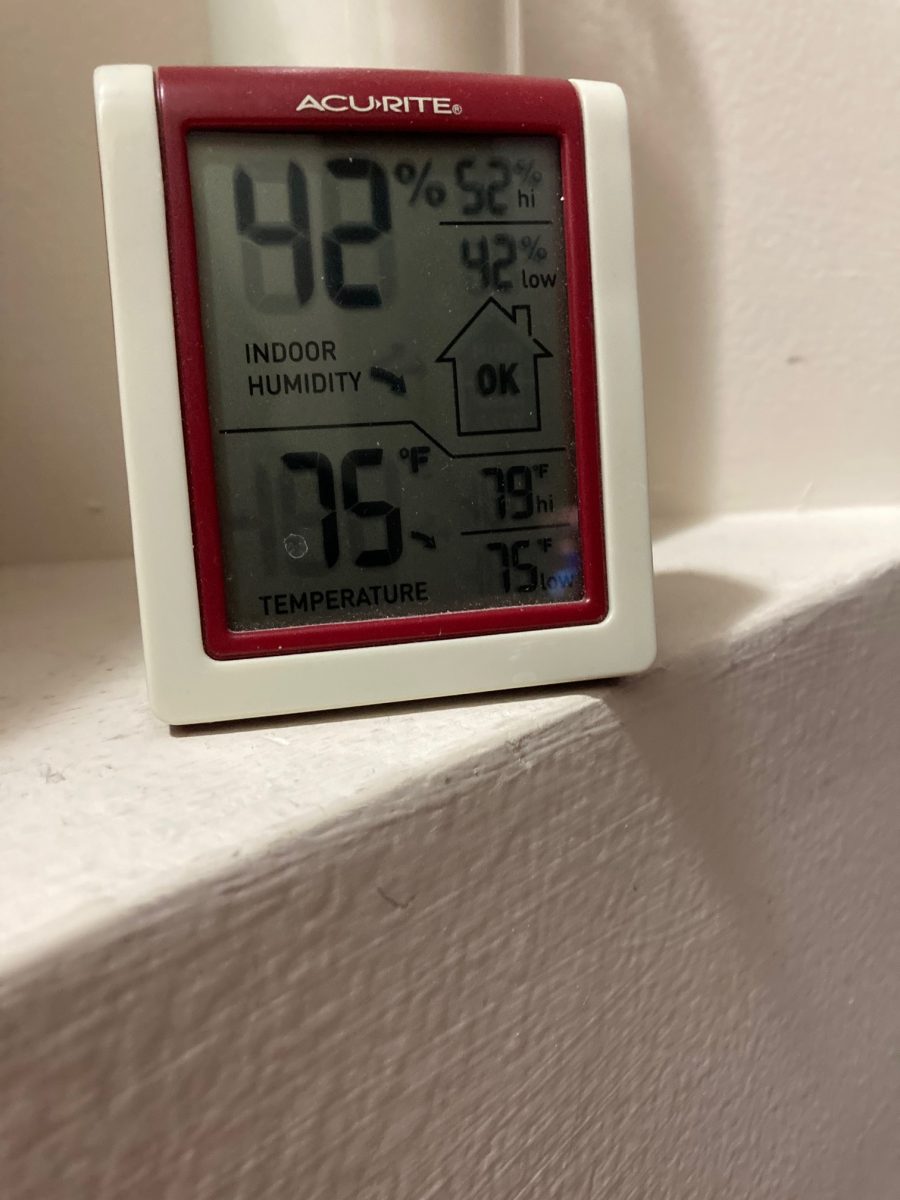
It took their technician less than 20 minutes to properly increase the blower speed and increase the time air is exposed to the coil.The technician also found and fixed the straining noise the unit was making.
It took only about two hours for the humidity to drop to 47 percent.
I sent my final reply to our former HVAC company: “I am deeply sorry that you were put off by a female customer telling you what an HVAC system’s problems were, or what was needed, like the TXV you initially said was not needed, but did get your technicians to install. … Please try not to kill the messenger in the future.”
Another 24 hours later, our indoor humidity was at 42 percent. From there, it has ranged from 39 to 47 percent. Happily ever after, I hope.©
THE END
— Nan Carol Kibbee is a Natural Interiors® design consultant and an Ohio Realtor®. Contact her at (513) 200-9471.
No Comments