Author: Natural Interiors®

Complaints about carpet pad odors show that researching the underlayment is just as important as the carpet that goes over it green-labelThe homeowner was almost distraught. She had just invested in a high-quality nylon carpet, only to deal with chemical fumes throughout her home as soon as the installation was complete. Now, she was spending hours doing research on the Internet, and she called Natural Interiors® for help. She had a remnant of the carpet and had isolated it long enough to know that it was not the problem. The odors, she had determined, must be coming from the carpet pad. “Can you tell me about chemical-free wool carpet and pad that you carry?,” she asked. “I am thinking that I may need to redo this whole project.” I replied: “Is the company that sold you the carpet and pad going to give you your money back? It would be a real shame for you to have to pay twice for the same job.”

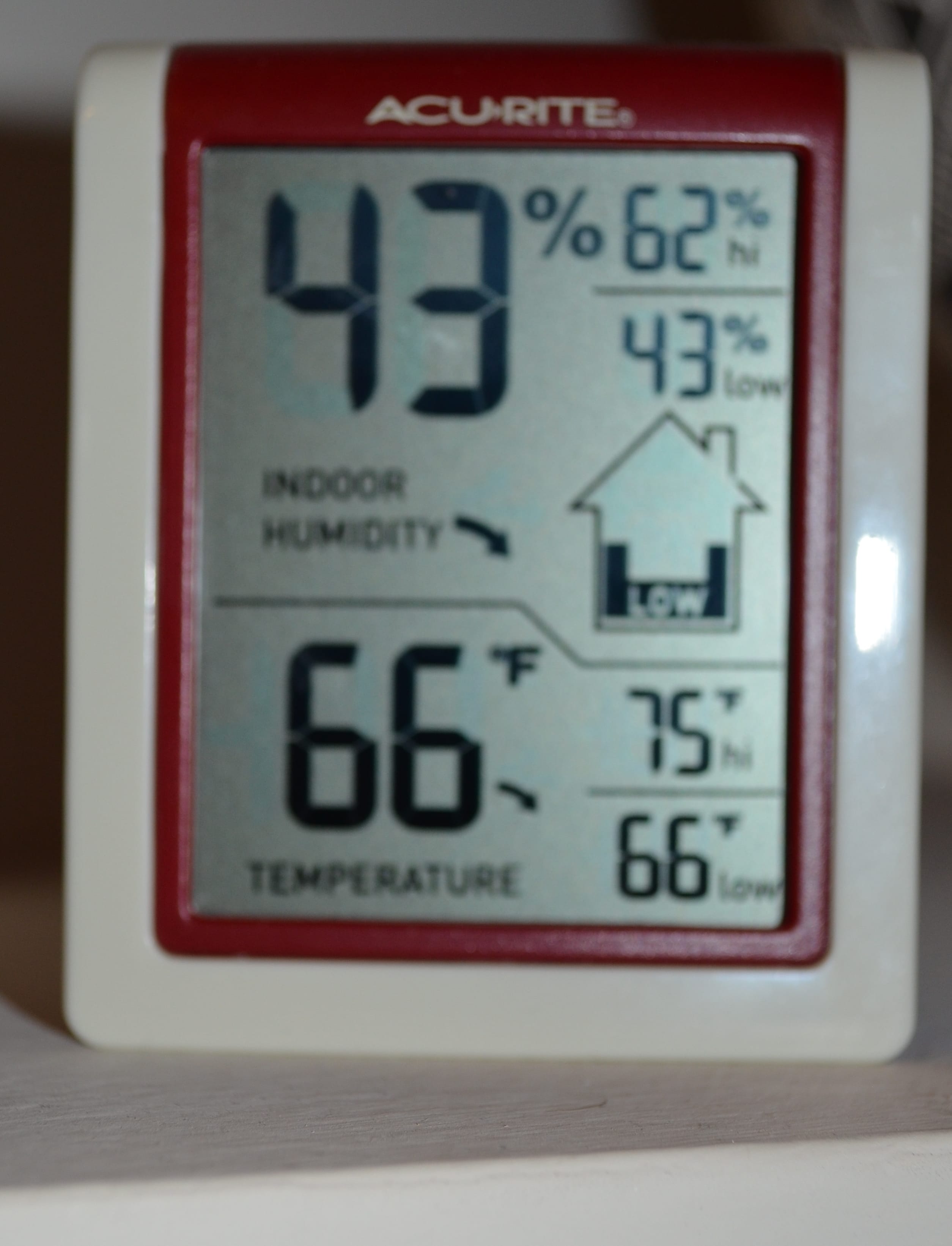
Temperature changes of winter and summer should remind you to get a hygrometer, even if you don't have hardwood floors DSC_0568Colder temperatures usually mean drier air – inside and outside. That’s why hardwood flooring manufacturers issue written guidelines that the owner must keep indoor relative humidity levels between 39 and 60 percent. When humidity drops too low, the floor with shrink. Too high, it will expand and cup. But most people have no idea what their indoor humidity levels are at any given moment. And there are more reasons to know than just for maintaining your flooring’s health. It is important for your own health, too.

U.S. vinyl flooring manufacturers are aware of the dangers and have taken steps to eliminate phthalates from their vinyl products. To be sure, there are questions you should ask. DSC_0325Q: I have put my plans to put vinyl flooring in my kitchen and family room on hold because of news reports about phthalates in vinyl flooring. Why is this information just coming out now, and can you recommend an LVT (Luxury Vinyl Tile) that does not contain these chemicals? A: This is not new news. The Consumer Product Safety Commission and the U.S. EPA have been looking at potential health concerns with phthalates for more than a decade. It began in the 1990s, with studies, and then rules restricting phthalate use in children’s items, like rattles and teethers  -- things that they would routinely put in their mouths.  Flooring was not on the list. More recently, the U.S. EPA has issued an action plan for several phthalates, some of which have been used in vinyl flooring.


Low- and zero-VOC hardwood finishing program expands with architect’s vision OLYMPUS DIGITAL CAMERACincinnati Architect Adam Fosnaugh was in awe of a wood floor made in Denmark. It was the look he wanted for the first floor of the Clifton home he and his wife are remodeling. Could we recreate this aesthetic?, he asked. It was White Oak plank, bleached in color, not too white, but no yellow tones that are typical with traditional hardwood finishes. Oh and yes, it had to be low- or zero-VOC. Adam is a LEED AP at MSA Architects. His wife, Margot, is a chemical engineer and air quality consultant, and they have a 1-1/2-year-old daughter. Indoor-air quality, in addition to the perfect color, also would be important for the cork flooring they would select for the second floor.

Indo Teak flooring is durable and planet-friendly, but also serves as a tribute to the travels of St. Xavier DSC_0297Don’t be misled by the Forest Stewardship Council (FSC) Certification that comes with this Teak flooring. It does not mean the wood came from a sustainably managed forest. Instead, it comes from deconstructed structures in Indonesia – some up to 300 years old. And it has proven  to  be the perfect look for the northern foyer at St. Xavier Church in downtown Cincinnati.  Church administrators' desire for sustainable products and durability was a key reason Architects Paul Duffy and Adam Luginbill  at glaserworks selected it.

Questions about chemicals in flooring are now common for the mainstream flooring shopper FloorScore LogoSomething is changing in the flooring industry. Customers are asking more frequently about what chemicals the products contain. Though there is no national statistic on what percent of the population has concerns, it is safe to say that 2015 should go down in history as the year mainstream consumers gained noticeable awareness of how flooring can impact indoor-air quality and human health. It started in March, with the 60 Minutes report that alleged excessive formaldehyde was being emitted from cheap glue used to make some of Lumber Liquidator’s laminate flooring in China. A second wave of concern erupted weeks later when it was announced that The Home Depot would phase-out sales of vinyl flooring that contained ortho-phthalates.

Confusion and half-truths follow report of excessive formaldehyde in some Lumber Liquidators’ laminate floors Carb II CompliantA customer who has seen the 60 Minutes report about unhealthful levels of formaldehyde in certain laminate floors from Lumber Liquidators now is questioning a flooring purchase she was about to make. “No worries,” her salesman says. “All of our flooring meets California Air Resources Board (CARB) standards for formaldehyde.”  He is misleading, but not intentionally. To assist its salespeople, a national retail group issues an alert to its members that reads: “All of our laminate flooring meets CARB 2 standards.”  Another over-simplification. Most flooring retailers – including those touting “natural” products – have limited understanding of how to gauge a floor’s impact on indoor-air quality. Understanding the evolution of people-friendly products, and keeping up with the ever-changing status of which manufacturer has added a certification and what the certification means, is a specialized field of its own. Compounding the confusion, certifications expire annually.

Onsite, UV-cured hardwood floor finishes are starting to beam BulldogWe talk a lot about low-VOC (Volatile Organic Compound) floor finishes, and the scientific advancements that have produced less-toxic polyurethanes and natural oil floor coatings.  But the truth is that our search for the perfect people-and planet friendly option continues daily. “Water-based” and “waterborne” now are second only to “low-VOC” on the list of buzzwords that put our minds at ease. But when you consider that zero-VOC paints are readily available, the VOC content in floor coatings can seem high, in addition to other chemicals that some formulas use. This reality has made the ultra-violent curing machine the latest proven weapon in our arsenal of remedies for unhealthful indoor air. It stops chemical emissions by instantly curing the finish that would ordinarily take days to weeks to completely dry and stop off-gassing. In addition, waterborne polyurethanes with VOC content as low as 17 grams per liter are now available.

Couple turns former Anderson Township barn into spectacular natural home [caption id="attachment_4423" align="alignleft" width="168"]After After[/caption] It started with a vision: Preserve the spacious serenity.  Restore and transform the barn into the grand centerpiece. Gaze out from any window and feel the tranquility of sprawling pastures, a winding creek and the natural acoustics of wildlife and waterfalls. Instead of a collective group of neighboring farmers ready to hoist the beams and hammer the nails, it took 18 months of intense focus by Karen and Jerry Whitney who, all the while, lived in a trailer on the property. [caption id="attachment_4438" align="alignleft" width="210"]Before Before[/caption] "It’s sustainable,” Karen says. “It was the natural thing to do, and it has paid off in the way the home looks and feels. Coming home from work is like entering a spa or a retreat.”