

12 Oct Cork 2010-Style
Part One: A Focus on the Finish
You might not see it. But when you inspect the most popular cork floors, you’ll feel the difference.
 The surfaces on prefinished cork floors range from rough to smooth. The looks range from stone-like to clear and natural.
Only the leaders have obtained “green” certifications that prove their products don’t release harmful levels of chemicals. And there is a little debate over whether some of the harder finishes chosen for durability belong on a softer floor like cork.
In many cases, traditional water-based polyurethane finishes have been replaced or fortified with components that include aluminum oxide, ceramics or acrylics. This means that you should consider what surface will be best for your daily routines. How much traffic will the floor need to withstand? Will you be sitting on the floor? Will your children be crawling on the floor? Do you want a floor that can be re-coated like hardwood? And how careful are you about maintaining healthful indoor-air quality?
The Wicanders has a dull, milky look and is rough in comparison to the Eco Cork from US Floors.
Wicanders
Wicanders (www.wicanders.com) — one of the most recognized names in cork flooring — has a somewhat coarse finish for a good reason, says Theresa Cesario, executive assistant for Wicanders. The company’s WRT (Wear Resistant Technology) ceramic finish stands up to tough traffic, she says.
“With this finish, you don’t see your wear patterns …,” she says. “It’s been used in daycare centers and yoga studios. If it was too rough, these installations would not be as successful as they have been.”
The Wicanders WRT finish consists of six coats of water-based polyurethane, with the top two layers containing ceramic beads. Unlike most cork manufacturers who recommend periodic recoating of the floor for maintenance, Cesario says Wicanders floors are not designed to be recoated.
Wicanders has GREENGUARD Environmental Institute Indoor-Air Quality Certification (www.greenguard.org). The company also has a high performance commercial finish that includes a layer of vinyl and a coat of microscopic nano beads.
Qu-Cork
Nano scratch- and scuff-resistant finish has been standard on all Qu-Cork (www.qucork.com) prefinished cork products for a few years.
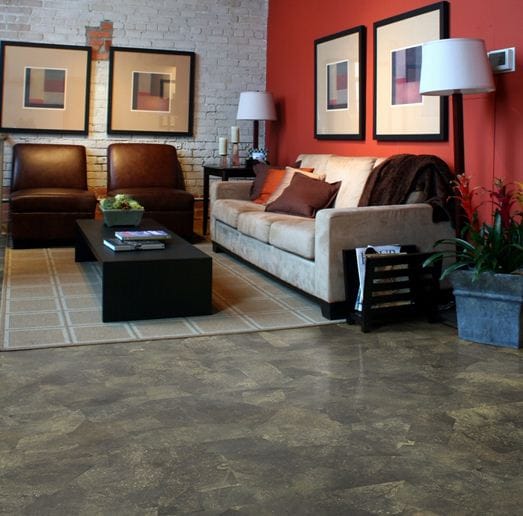 The nano particles used to coat the floor are 100,000 times smaller in diameter than a human hair. This ensures that every surface on the floor is coated for maximum protection of the floor in addition to providing a smooth, natural-appearing surface. In addition, nano finish is particularly flexible or elastic, which is important because cork moves and compresses.
“Children can crawl and play on it without getting floor burn,” says R. Lanny Trottman, president of Global Market Partners, Inc., which supplies Qu-Cork.
Qu-Cork can be easily recoated, and an extra coat of Qu-Cork Commercial Finish after installation is recommended for commercial installations. Qu-Cork also has GREENGUARD Children & Schools Indoor Air Quality Certification, the toughest standard set by this third-party certifier. (Image “Midnight Slate,” Qu-Cork.)
USFloors
The Natural Cork (www.usfloorsllc.com) collection, which includes EcoCork, features US Floors’ Endura and Endura AR finishes – both water-based, proprietary finishes containing aluminum oxide, acrylic and ceramics. These finishes are specially formulated to provide the best balance of scratch- and scuff-resistant technology and a natural cork appearance in addition to accommodating the natural movement, or resiliency, of cork.
“Our finish is formulated to take that into consideration,” says Gary Keeble, Jr., marketing manager for USFloors.
The Natural Cork collection can be recoated, and US Floors recommends one or two more coats of Rigostep C-800 after installation for commercial installations. USFloors also has GREENGUARD Children & Schools Indoor Air Quality Certification.
Expanko
This company’s prefinished line uses three coats of water-based polyurethane, which provides a relatively smooth, natural appearing surface. Recommendations from Expanko (www.expanko.com) differ from manufacturers who do not recommend extra coats of finish for a typical residential installation.
 “Additional coats of finish (Bona Kemi Traffic) are recommended to seal all joints in the floor,” says Randy Gillespie, company spokesman. “This prevents the penetration of moisture into the system. All cork flooring should be addressed with an after-installation coat of finish.”
While Expanko has received FloorScore indoor-air quality certification for its XCR4 Cork Rubber flooring, it has not submitted its cork flooring for testing, Gillespie says, because the cork is a natural material and its factory finish is low-emitting, so the company does not feel that this certification is necessary. (Image “Pacific Origins,” Expanko cork.)
We Cork
We Cork’s, (www.wecork.com), prefinished flooring uses three coats of Greenshield – a water-based polyurethane finish with aluminum oxide. The product does not have GREENGUARD or FloorScore indoor air quality certification. The company did not respond to a phone message and an email asking for additional information.
APC Cork
According to its website, APC Cork’s (www.apccork.com) prefinished flooring uses three coats of acrylic varnish, and additional coats are recommended as needed. APC does not have GREENGUARD or FloorScore certification. The company did not respond to a phone message and an email asking for additional information.
Duro Design
This company is most known for its color selection with the Duro Design (www.durodesign.com) cork line offering 54 colors. The floor is prefinished with Duro Design’s MP 765 water-based polyurethane, which the company says is formulated for superior durability, abrasion resistance, clarity and resilience.
Duro Design’s floors can be recoated. The company does not have GREENGUARD or FloorScore indoor-air quality certification.
Scarlet Kivioja
Posted at 11:29h, 03 NovemberIs this WP theme premium or free ? Really nice!
Nancy Kibbee
Posted at 11:45h, 03 NovemberIt wasn’t free, for sure.
Hugh
Posted at 10:26h, 13 NovemberHi Nancy.I am currently renovating a hot yoga studio in Mississauga,Ontario.Currently on the floor is cork .The product is Wicanders S1000 tile.The heat used in the room is forced air with a humidity control/heat sensor on the wall.Can you recommend a
water based polyurethane product I can install over the existing cork flooring.It would have to withstand the heat
and traffic.Also the manager told me when the cork was installed all the seams were glued with Bona clear seal.
Thankyou for any informatin.Great site.
Nancy Kibbee
Posted at 10:10h, 15 NovemberHugh — While Wicanders is not designed to be recoated, I have checked with them, and the floor can take a coat of their W2000 urethane. The steps involved include cleaning the floor with Wicanders Power Strip, and sealing with their Primer Power Contact, which is needed to help the urethane stick to the finish on the floor. If you cannot locate these products locally, you can call them at 410-553-6062.
On another note, if the floor already has been used in the hot yoga setting, this probably isn’t an issue. But some manufacturers advise caution because the extreme heat, then cooling at night, and changing humidity levels, can lead to excessive expansion and contraction of wood products, including cork. So this may be something to keep your eye on.
Thanks for checking with us, and let us know if we can help further!
Pingback:Part Three: Cork 2010-Style | Natural Interiors® Blog
Posted at 12:10h, 03 December[…] or floating cork floors – coupled with stronger finishes discussed in Part One – have led to a rise in cork sales because they give the floor more protection from moisture, […]
Randy Gillespie
Posted at 15:57h, 15 DecemberThe Bona Kemi Traffic finish on the cork tiles is Green Guard Certified. The cork tiles themselves are not certified by any third party.
Pingback:A Qu-Cork Catwalk | Natural Interiors® Blog
Posted at 06:15h, 28 February[…] Interiors has featured Midnight slate in Cork 2010-Style. Qu-Cork has GREENGUARD Children & Schools indoor-air quality certification and is finished […]
Pingback:Cork 2011-Style | Natural Interiors® Blog
Posted at 13:40h, 10 June[…] finishes vary, and should be taken into consideration, (see Focus on the Finish). Snow notes that Natural Cork from USFloors and WE Cork have some of the smoothest finishes on the […]
Pingback:Ask this Green Floor Guy -- and Gal | Natural Interiors® Blog
Posted at 05:13h, 27 October[…] some of these finishes feel to the touch and perform, so make sure you like the one you choose. See Focus on the Finish. There also are many patterns and plank styles to choose from, see Cork […]
Pingback:Ask this Green Floor Guy — and Gal | Home Improvement Blogs
Posted at 10:09h, 27 October[…] some of these finishes feel to the touch and perform, so make sure you like the one you choose. See Focus on the Finish. There also are many patterns and plank styles to choose from, see Cork […]
Inga
Posted at 13:15h, 14 NovemberWhat type of floating cork floor is best for severe asthmatics (zero formaldehyde and other VOCs, etc.)? Thanks.
Nancy Kibbee
Posted at 15:32h, 14 NovemberThe issue of what triggers asthma varies from individual to individual. In addition, some formaldehyde is naturally occurring and is emitted by virtually all wood products, regardless of what is or is not added to it in manufacturing.
If you are set on cork, the best you can do is look at the testing and certifications on the product, so you know what chemicals they emit and at what levels. Not all cork manufacturers have sought indoor-air certifications, but Wicanders and Qu-Cork have GREENGUARD indoor-air certification. There is more information about chemical limits set by this certification on this site under Featured Blogs and at http://www.greenguard.org.
Marge Lachowski
Posted at 02:54h, 30 Novemberyou are really a good webmaster. The site loading speed is amazing. It seems that you are doing any unique trick. Moreover, The contents are masterpiece. you’ve done a fantastic job on this topic!
Pingback:Cork 2012 Style, Part II | Natural Interiors® Blog
Posted at 09:49h, 10 April[…] the floor with be HDF (High Density Fiber Board). And if the flooring – engineered or solid – will be prefinished, anything from a simple water-based polyurethane to a proprietary aluminum oxide or ceramic finish, […]
Pingback:The Many Faces of Cork | Natural Interiors® Blog
Posted at 14:11h, 07 August[…] best performance. Visit Natural Interiors® blogs for information on different styles, different finishes and points to consider in choosing a cork floor.© […]
Misti Keppler
Posted at 15:41h, 22 SeptemberHello there! Would you mind if I share your blog with my twitter group? There’s a lot of people that I think would really appreciate your content. Please let me know. Thanks
Bästa Pris Nike Herr Running Mörk Obsidian Ljust Crimson Midnatt Marin Rio Air Max
Posted at 04:35h, 16 SeptemberAppreciating the commitment you put into your site and in depth information you provide. It’s great to come across a blog every once in a while that isn’t the same old rehashed material. Excellent read! I’ve bookmarked your site and I’m including your RSS feeds to my Google account.